
Quick answer: rank providers against your household, not against a league table
There is no single best IPTV service for every Canadian household. The service that suits a Montreal family watching French-language news and Habs games is not automatically the one that suits a Vancouver household streaming 4K movies on three screens. A ranking is only useful once it states what it measured and why that measure matters to you.
This guide sets out ten provider profiles, ranked by the household need each one serves best, together with the evidence you should require before paying for any of them. It is a decision method with worked criteria, not a laboratory report.
IPTVCA.CA publishes this guide and sells IPTV subscriptions through this website. That is a commercial interest, and you should weigh it. The guide therefore avoids publishing unverified specifications for any named competitor, and it tells you how to check every claim yourself — including ours.
What a ranking can honestly claim
A published ranking usually rests on one of four foundations, and they are not equally strong.
Direct measurement is the strongest. Somebody subscribed, streamed, and recorded results with a stated method, at stated times, on stated hardware. Documented specification is next: the provider publishes a figure and stands behind it. Third-party reporting is weaker, because it inherits the original method's limits. Assertion is the weakest — a number appears with no source at all.
Most "best IPTV" lists online sit in the fourth category. Channel counts, uptime percentages, and price tables appear without any indication of when they were checked or by whom. Those numbers may be accurate. There is simply no way for a reader to tell.
| Foundation | What it proves | What it cannot prove |
|---|---|---|
| Direct measurement | Performance during that test | That the result holds at peak hours or on your connection |
| Documented specification | What the provider commits to publicly | That delivery matches the commitment |
| Third-party report | That someone else observed it | Anything the original method did not establish |
| Unsourced assertion | Nothing verifiable | Anything at all |
Treat any figure in any ranking, including the profiles below, as a starting question rather than a settled fact.
How these ten profiles were assembled
Each profile describes a household need, the provider characteristics that serve it, and the specific evidence to demand. Where a characteristic can be verified from a provider's own published material, the profile says to check it there. Where it cannot, the profile says so plainly instead of supplying a number.
Six criteria shape every profile:
Content fit. Does the service carry the specific channels, leagues, or language feeds this household actually watches? A large total channel count is not the same as carrying the twelve channels a family uses.
Concurrent streams. How many screens may play at once under the account terms, not merely what the network could technically carry.
Device support. Which apps and boxes are officially supported, and which are merely known to work.
Stability during peak demand. Performance during a Saturday evening hockey game is the test that matters, not a Tuesday afternoon.
Trial and refund terms. Whether the service lets you evaluate before committing, and what the refund conditions actually say in writing.
Licensing and legal position. Whether the service holds distribution rights for the content it carries.
That last criterion carries more weight than the rest combined, and the next section explains why.
The legal position, stated plainly
IPTV as a technology is entirely legal in Canada. Delivering television over an internet connection is how Bell, Rogers, and Telus deliver many of their own subscriptions.
The legality question attaches to content rights, not to the delivery method. A service that holds distribution agreements for the channels it carries operates within Canadian law. A service redistributing channels without those agreements does not, regardless of how professional its interface looks or how it describes itself.
This distinction is not always visible from a provider's website, and it is the single most consequential thing a subscriber can get wrong. Before paying any provider, ask directly whether it holds Canadian distribution rights for the channels you intend to watch, and what documentation supports that. A provider unwilling to answer that question has answered it.
Reputable services are generally willing to discuss licensing. Evasion, offshore-only contact details, cryptocurrency-only payment, and channel counts in the tens of thousands are all signals worth taking seriously.
Signals that should end an evaluation early
Some characteristics are strong enough to stop the assessment rather than merely lower a score. They are worth checking first, because they save the effort of evaluating everything else.
A channel count in the tens of thousands is the clearest. Legitimate distribution agreements are negotiated channel by channel and region by region; no Canadian licensing arrangement produces twenty thousand channels. A figure that large indicates the service has not licensed what it carries.
Payment method carries similar weight. A service accepting only cryptocurrency or irreversible transfers has chosen an arrangement that leaves subscribers without recourse and leaves itself difficult to trace. That choice is informative about how it expects disputes to end.
No verifiable business identity is the third. A Canadian business should be identifiable — a registered name, a physical address, a way to reach a person. A website with a contact form and nothing else provides no route to resolution when something goes wrong.
| Signal | What it usually indicates | Weight |
|---|---|---|
| Tens of thousands of channels | Content carried without licensing | Disqualifying |
| Cryptocurrency-only payment | No subscriber recourse by design | Disqualifying |
| No identifiable business entity | No route to resolution | Disqualifying |
| Refuses to discuss licensing | Answer given by the evasion | Serious |
| Lifetime subscription offers | Revenue model that does not sustain service | Serious |
| No trial of any kind | Confidence in the product is absent | Worth questioning |
| Undated channel list | Lineup may no longer be accurate | Worth questioning |
The last three are not automatically disqualifying, but each shifts the burden onto the provider to explain itself. A good answer exists for some of them; the absence of any answer is itself the finding.
Ten provider profiles by household need
The comparison table below summarises the profiles. Each entry names the household it serves and the evidence to require. Where a slot describes a profile rather than a named brand, that is deliberate: this guide does not publish brand specifications it has not verified.
| # | Best for | Decisive criterion | Evidence to require |
|---|---|---|---|
| 1 | Live Canadian sports | Peak-hour stability | Trial during an actual game |
| 2 | French-language households | Québec channel carriage | Named channel list |
| 3 | Large multi-screen homes | Concurrent stream allowance | Written account terms |
| 4 | 4K and high-bitrate viewing | Sustained bitrate delivery | Measured playback test |
| 5 | Firestick and Android TV users | Official app support | Publisher's app listing |
| 6 | Smart TV without extra hardware | Native app availability | Platform app store |
| 7 | Budget-conscious households | Total annual cost | Published renewal price |
| 8 | Newcomers to IPTV | Setup support quality | Response before purchase |
| 9 | International channel needs | Specific regional feeds | Named channel list |
| 10 | Reliability above all | Documented uptime method | How uptime is measured |
1. Live Canadian sports
Sports is the least forgiving use case. A twenty-second buffer during a goal is remembered in a way that a buffer during a documentary is not, and sports traffic peaks precisely when every other subscriber is also watching.
Require a trial that covers an actual live game at its actual broadcast time. A provider that performs well at 2 p.m. on a Wednesday has told you very little about Saturday at 7 p.m. Ask specifically which sports channels are carried and under what rights.
IPTVCA.CA serves this profile. We sell subscriptions, so treat that as a disclosed interest rather than an independent finding, and test us the same way you would test anyone else. Our 24-hour trial exists for that purpose, and the channel list names what is carried.
2. French-language households
Québec households and francophone families elsewhere in Canada need specific channels, not a general promise of French content. Ask for the named list and check it against what the household actually watches.
Regional carriage varies more than most providers' marketing suggests. A service may carry French-language international channels while lacking Québec-produced programming, which is a meaningful difference for most francophone subscribers.
3. Large multi-screen homes
The constraint here is contractual, not technical. Most providers cap simultaneous streams per account, and that cap appears in the terms rather than in the marketing.
Ask how many streams the account permits, whether the limit is enforced, and what happens when it is exceeded. A household with four televisions needs this answered in writing before purchase, not discovered on a busy evening. Our pricing page states what each IPTVCA.CA plan permits.
4. 4K and high-bitrate viewing
A 4K label on a channel list describes an intention, not a delivered bitrate. The meaningful question is what bitrate arrives at the television during normal viewing.
Measure it rather than accepting it. Our speed test establishes what your connection sustains at the viewing device, which is the number that matters — distinct from the advertised plan speed. Then confirm during a trial that the stream itself uses that headroom.
5. Firestick and Android TV users
Amazon Fire TV and Android TV are the most common IPTV platforms in Canadian homes. The distinction worth establishing is between an officially supported app and an app that merely happens to work.
Official support means updates, compatibility testing, and somebody to contact when a platform update breaks playback. Sideloaded workarounds offer none of those. Our installation guide covers the supported paths.
6. Smart TV without extra hardware
Households that prefer not to add a box need a native Samsung or LG application. Check the platform's own app store rather than the provider's claim, because that is where availability is actually determined.
Where no native app exists, the honest answer is that extra hardware is required. A provider that obscures this is worth less trust on other points.
7. Budget-conscious households
Compare total annual cost, not headline monthly price. Introductory rates, renewal rates, and multi-device surcharges frequently differ, and the renewal price is the one a household pays for most of the relationship.
Ask what the price becomes at renewal and get the answer in writing. A service that will not state its renewal price before purchase has given you useful information about how it operates.
8. Newcomers to IPTV
For a first IPTV subscription, support quality outweighs nearly every specification. Test it before paying: send a real question and judge the response time and usefulness.
Support that is responsive to a prospective customer is the best available predictor of support after payment. Our FAQ answers the common setup questions, and contact reaches a person.
9. International channel needs
Households watching South Asian, Arabic, Filipino, or European programming need named channels confirmed in writing. Regional packages vary substantially between providers and change more often than channel lists are updated.
Ask when the list was last revised. A list dated two years ago describes a lineup that may no longer exist.
10. Reliability above all
Uptime claims are common and rarely defined. Ninety-nine point nine percent uptime is meaningless without knowing what was measured, over what period, and by whom.
Ask how the figure is produced. A provider that measures honestly can explain its method; one that cannot explain it is quoting a number it did not generate.
How to verify any provider in one evening
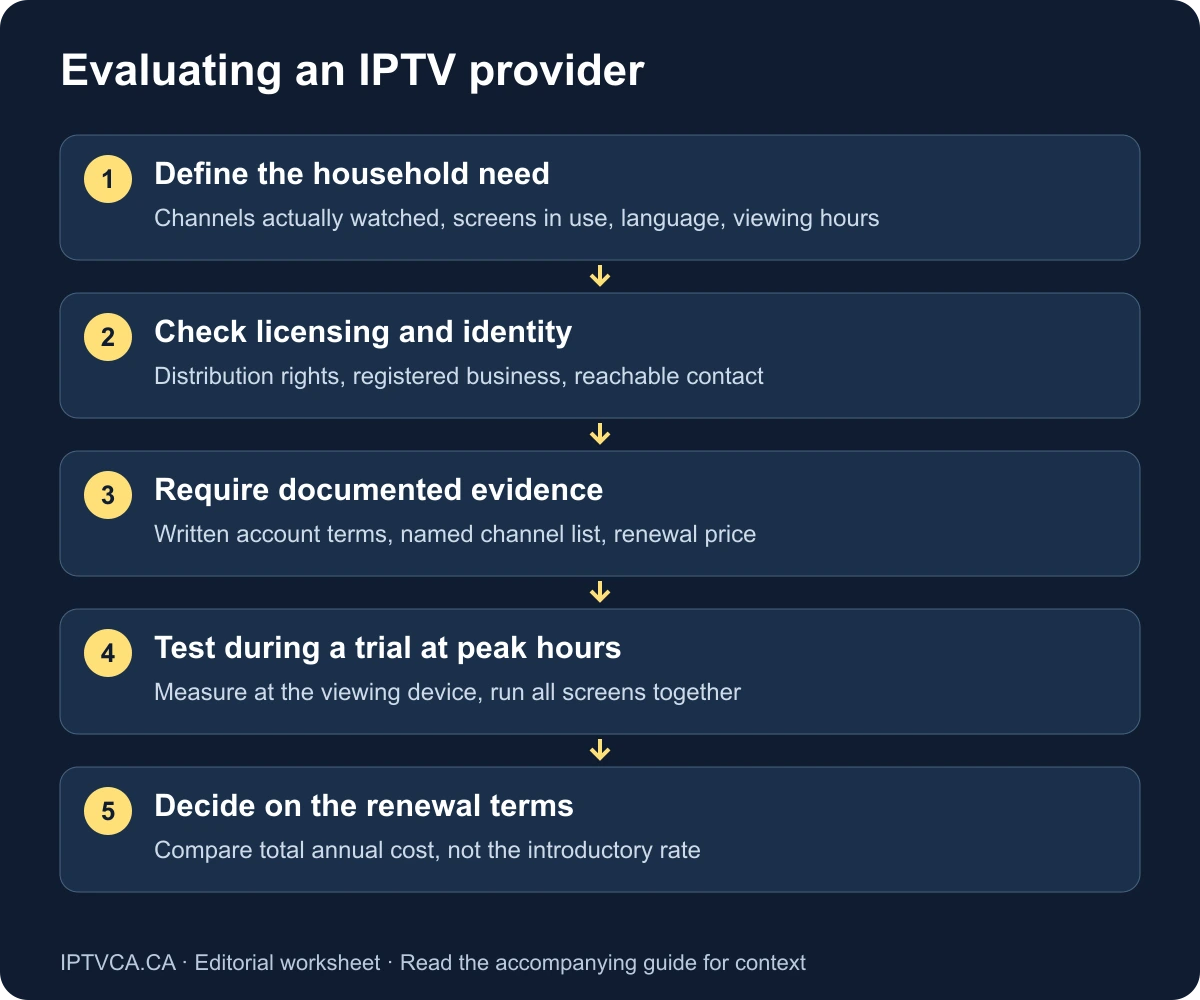
A structured trial produces better evidence than weeks of reading reviews.
Start by measuring your connection at the television itself, not at the router, during the hours you actually watch. Then start the trial and watch something live during peak evening demand. Play the specific channels the household cares about, not a sample of whatever loads first. Open a support conversation with a genuine question. Finally, read the renewal and refund terms before the trial ends.
Write down what you observe, with times. Four evenings of dated notes will tell you more about a service than any published ranking, including this one.
| Check | When to run it | Record |
|---|---|---|
| Speed at the viewing device | Peak evening hours | Mbps, time, wired or Wi-Fi |
| Live playback on a wanted channel | During an actual broadcast | Stalls, recovery time |
| Simultaneous streams at the account limit | All screens together | Which stream degraded first |
| Support response | Before paying | Hours elapsed, whether answered |
| Renewal and refund terms | Before the trial ends | Price at renewal, refund window |
The third row is the one most households skip and most regret skipping. A service that handles one stream cleanly may behave differently with the household's full load running, and that is the condition it will face every evening after purchase.
What changes after the first payment
Most disappointment with an IPTV subscription arrives later than the first week, and the causes are predictable enough to check for in advance.
Renewal pricing is the most common. An introductory rate creates one impression of cost and the renewal rate creates another. Establish the second number before committing to the first.
Channel lineups shift as carriage agreements are renegotiated. A channel present at signup may be absent months later, and that is normal for every television service including cable. What differs between providers is whether they tell subscribers in advance. Ask how lineup changes are communicated.
Account limits are sometimes enforced more strictly over time. A service may tolerate an extra stream initially and later enforce the documented cap. Plan around what the terms permit rather than what currently goes unchallenged.
None of these are unique to IPTV, and none indicate a service is acting badly. They are ordinary characteristics of subscription television, and a provider willing to describe them plainly before purchase is demonstrating something useful about how it operates.
Frequently asked questions
Is IPTV legal in Canada? The technology is legal. Services holding distribution rights for their content operate within Canadian law; services redistributing channels without those rights do not. Ask any provider directly about its licensing.
What internet speed do I need? It depends on how many streams play simultaneously and at what quality, plus the household's other internet use. Measure at the viewing device rather than relying on the advertised plan speed.
Can I test before paying? Reputable providers offer trials. IPTVCA.CA offers a 24-hour trial with no card required.
How many devices can I use at once? This is set by account terms rather than by your network. Confirm the permitted number in writing before purchasing.
Why does this list not publish competitor prices? Because we could not verify them. Publishing unverified specifications about other companies would make this guide less trustworthy, not more.
Choosing well
The provider that suits your household is the one carrying the channels you watch, permitting the screens you need, performing during the hours you view, and stating its terms in writing. No ranking can determine that on your behalf, because the decisive variables belong to your home.
Use the profiles above to decide what to require, then require it. If IPTVCA.CA meets those requirements for your household, the trial is the way to find out — and the same standard should be applied to every service you consider, ours included.